skeletor.binary1702.com
We inhabit our bodies every day, yet understand so little of what lies beneath the surface.
Skeletor is an exploration of human anatomy, revealing the intricate structures that make us who we are.
01History & Roadmap
History
2026-09-01
Day one. 307 MB file, 6 GB to open. Find another way.
2026-09-08
The whole body. 3,874 structures, 224MB → 34 MB.
2026-09-29
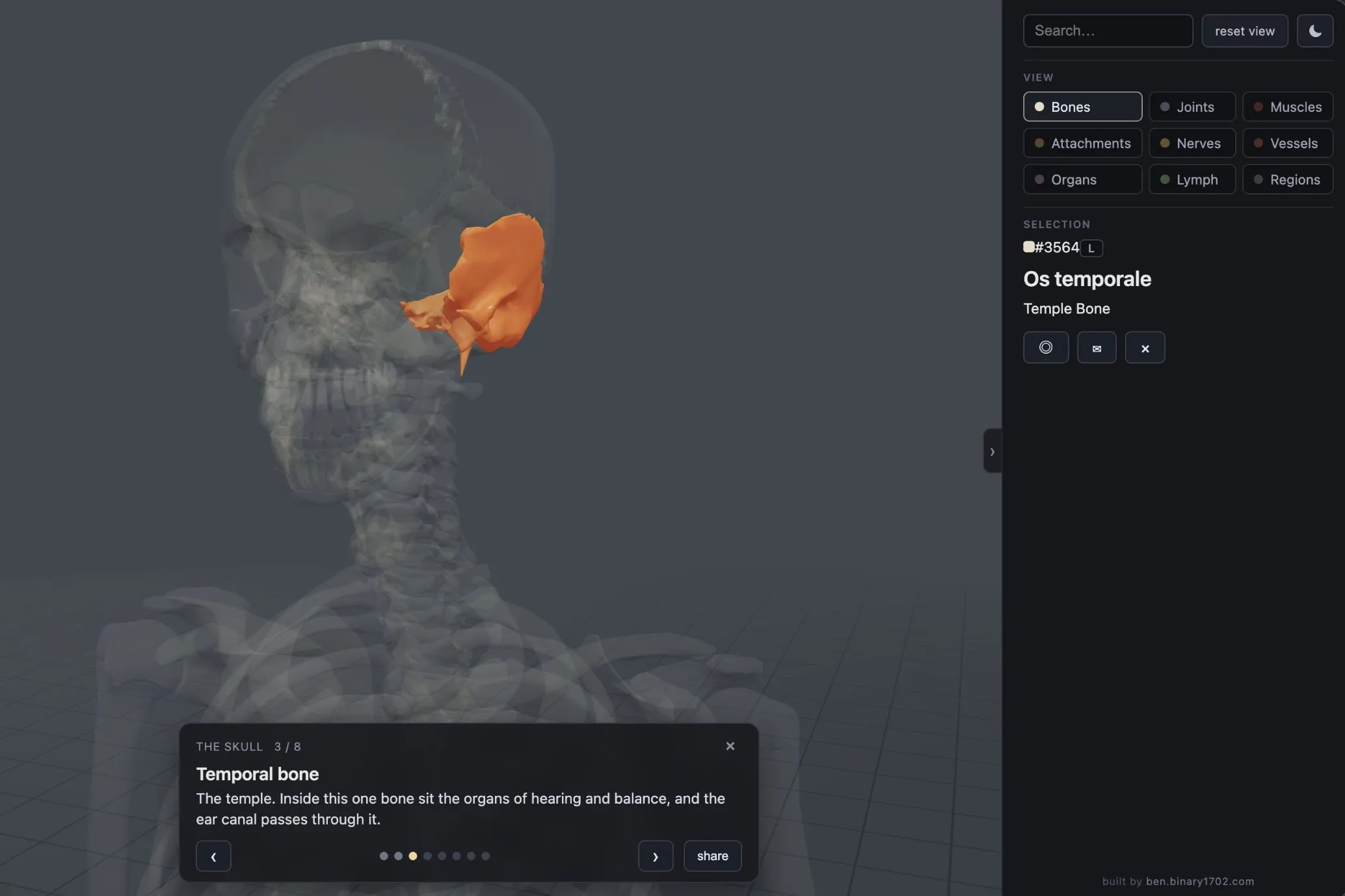
The skull study guide. Learning over engine.
2026-10-27
It gets a name. Skeletor.
Roadmap
The Living Atlas — The entire human body, interconnected in 3D.
The Intelligent Body — Understand deeply how the body works.
The Future of Medical Education
02Model Information
How many structures survive the pipeline.
Before
- skeletal277
- muscular683
- attachments705
- joints413
- cardiovascular676
- lymphoid163
- nervous588
- visceral119
- regions256
- other58
After
- skeletal277
- muscular683
- attachments705
- joints413
- cardiovascular676
- lymphoid163
- nervous582
- visceral119
- regions256
- other0
03Engineering Principles
01Systems Architecture
ETL pipelines / Batch processing / Memory optimization
Opening the source anatomical model as a scene evaluates 2,560 modifiers and passes 6 GB of memory. Rather than optimize an expensive operation, I redesigned the extraction pipeline to avoid it: the library is loaded with nothing linked to a scene, and export stages touch only what they export.
The complete dataset now processes in batches of 150 objects, with peak memory held at 2.7 GB.
6 GB+ → 2.7 GB peak memory · 55% reduction
02Data Engineering
Data modeling / Entity identification / Schema design
An anatomical structure exists independently of the terminology used to describe it. Names change, classifications evolve; identity must stay fixed.
Skeletor derives each primary id from the upstream object the source actually maintains, and carries the TA2 standard term alongside it as a secondary key. Curating a term never renames a structure or breaks knowledge attached to it.
3,874 stable ids · 76% mapped to TA2
03Computational Geometry
3D transformations / Mesh processing / Data validation
Left-side structures in the source are mirrored copies sharing the right side’s mesh. A mirror preserves appearance while reversing surface orientation: the model looks right and is mathematically wrong.
I bake each side into world space, flip the winding, and store left and right as independent meshes with identity transforms, at the cost of holding every pair twice.
Geometric integrity over storage efficiency
04Data Architecture
Domain modeling / Data preservation / Extensible schemas
Most anatomical applications keep the structures their use case needs. Everything else becomes expendable.
Skeletor preserves nine systems as first-class entities: bones, joints, muscles, attachments, vessels, nerves, lymph, viscera, regions. The system should not decide in advance which parts of the body deserve to be understood.
3,874 structures · 9 systems · 100% preserved